Deep Space Nine was the odd one out. Every other Star Trek is about a ship that goes somewhere new every week. This one is about a station that stays put — a battered outpost at the mouth of a wormhole, run by a widower who did not want the job, full of merchants and refugees and people trying to get the plumbing to work. It is the only Star Trek about usage: what you do with a place once you are stuck there and have to make it mean something.
I have come to think it is the one that matters most for this blog, and the reason is in the pilot.
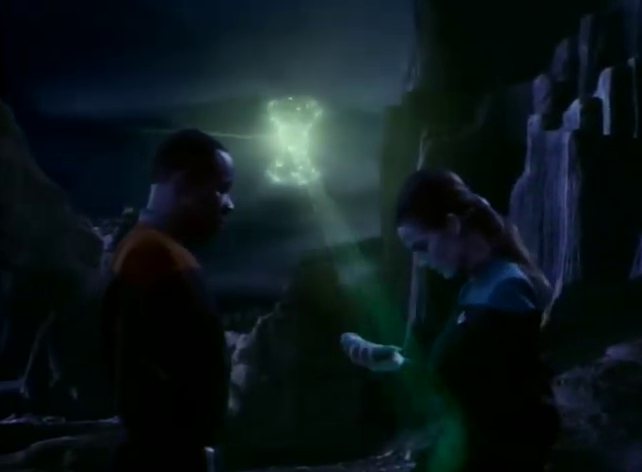
Commander Sisko goes into the wormhole and meets the beings who live inside it. The Bajorans call them the Prophets. They do not experience time the way we do — they have no before and after; everything that will happen has, for them, already happened. They cannot understand why Sisko keeps talking about the future, and they cannot understand why he keeps returning, in his mind, to the moment his wife died. And Sisko, a man who has no idea how to explain linear time to beings who have never experienced it, does the only thing he can think of.
He explains baseball.
He tells them that the pitch is thrown, and the batter does not know what will happen, and that is the point. The game is only a game because nobody inside it knows the ending. The not-knowing is not a flaw in the game. It is the game.
And then — this is the part I love — the Prophets turn it around on him. They show him that he is not living linearly either. He keeps going back to the moment of his wife’s death. He has been standing in that moment for three years. He exists there. And he cannot move forward until he sees that.
Here is why I have brought you to a station at the edge of a wormhole.
When I tell people the singularity is behind us, the most common reaction is a kind of vertigo — but it’s supposed to be coming. The dramatic map has put everyone in Sisko’s position: standing in one moment, waiting for a future that has, in the only sense that matters, already arrived. The three ingredients are in the kitchen. The recipe is written. The Prophets would not understand the fuss. From where they sit, the thing is.

And the second lesson is the harder one. Sisko is stuck in the past because he has not examined it. He has been carrying a moment without looking at it, and that is exactly what the dramatic map is — a moment of fear from a century of movies, carried without examination, until it becomes the only place anyone can stand. Know thyself, said the temple. Look at where you are standing, said the Prophets. Same instruction.
The station, by the way, works. By the end of seven seasons it is a city — a market, a temple, a school, a bar run by a Ferengi who has a rule of acquisition for every occasion. Nobody discovered anything. They used what was there. That is the whole of Part Two of the longer book, in a single setting.
Sisko becomes, in the end, something the Bajorans call the Emissary — the one who stands between the Prophets and the people and translates. He never wanted to be. He is a Starfleet officer and a father and a man who likes to cook. But somebody had to carry the recognition across, and he was the one standing there.
I know the feeling.