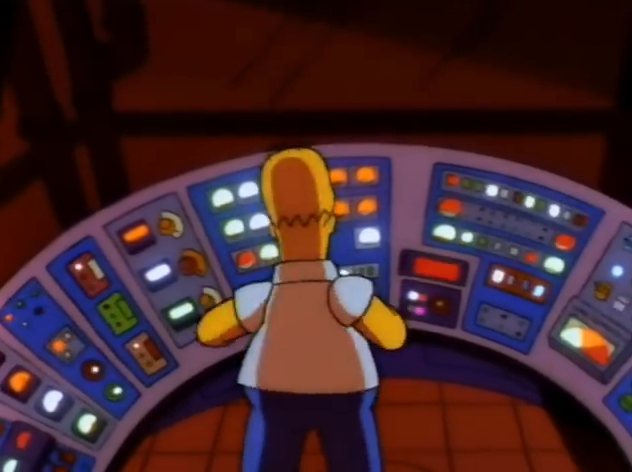
The single most reassuring image in the history of television, if you think about it for a moment, is Homer Simpson at his workstation in Sector 7-G of the Springfield Nuclear Power Plant.
Think about what that image is. Here is a man of modest gifts — the show has spent thirty-five years establishing exactly how modest — sitting in front of the control panel of the most dangerous technology human beings have ever built. He is eating a doughnut. He is asleep. He is pressing buttons at random to make a light stop blinking. And the plant, mostly, does not melt down. The town goes on. Lisa plays the saxophone. Bart skateboards past.
The joke, obviously, is that Homer is incompetent. But the deeper joke — the one the writers may not have fully intended and which has kept me up at night — is that the system was built on the assumption that someone like Homer would be sitting there. The panel has big buttons. The dangerous one is under a cover. The alarm is loud. The whole thing has been designed, by people much smarter than Homer, so that a man eating a doughnut can keep a reactor running.
That is usability. That is my entire career. And it is, I will argue, the actual mechanism of the singularity.
Here is the claim, in one line, and it is the heart of my longer book and the thesis I intend to defend in front of a room full of professors:
The singularity is behind us, and usability and usage are what carry it forward.
Let me unpack it with a word I use a lot: the conductor.
A conductor does not play an instrument. The orchestra has all the sound in it already — every note, every instrument, every player who has practised for twenty years. The conductor’s job is to decide when, and how much, and in what order. The conductor turns a room full of capability into a piece of music.
In 2026, the orchestra is built. The models can write and reason and see. The conductor is usage: the sequence of small, human decisions about how the capability gets picked up. And the thing that governs usage, more than anything else, is whether the technology is designed so that ordinary people can operate it without thinking — the Homer test. The cash-register test.
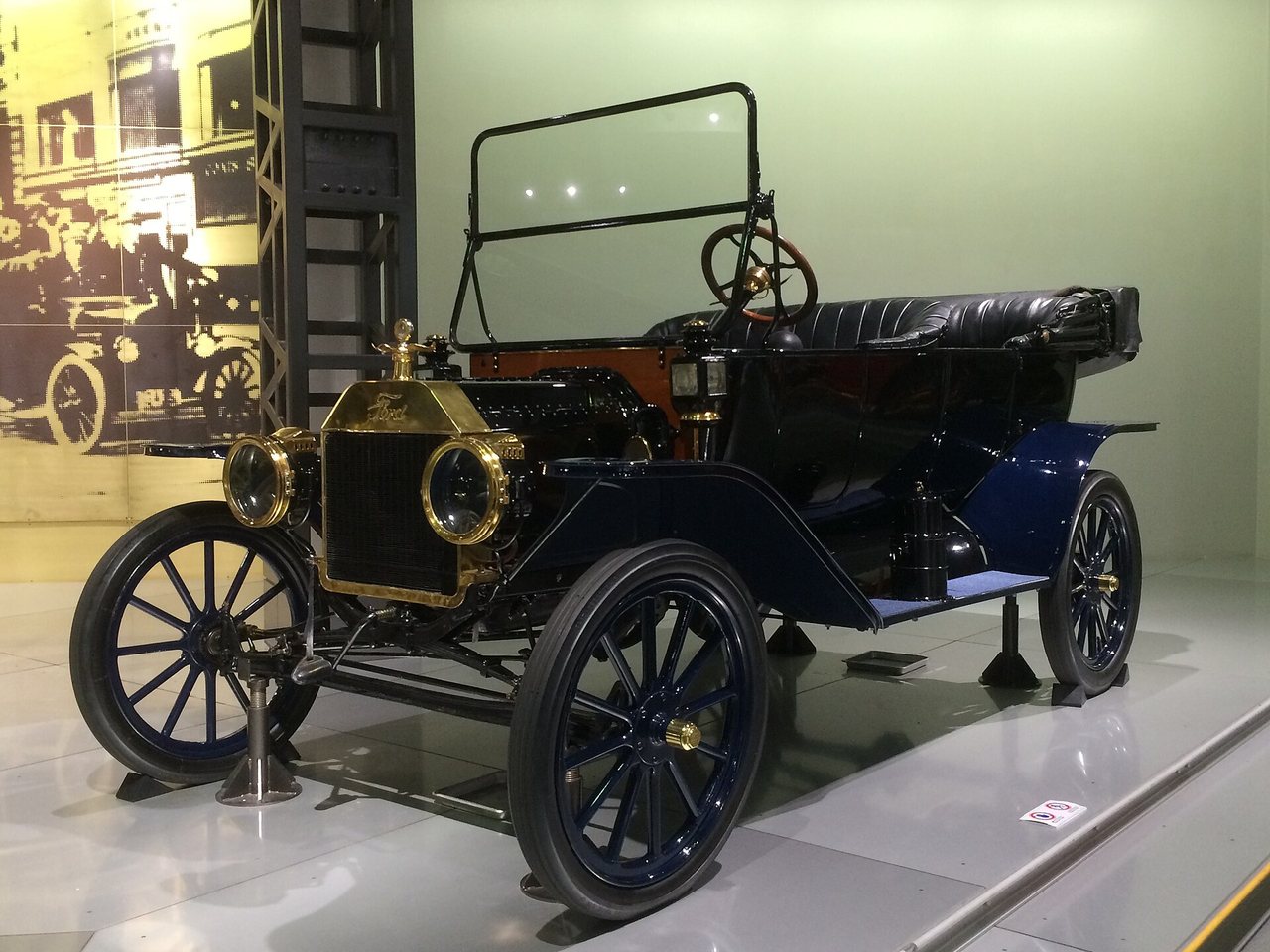
Every big technology follows this path. First it is possible. Then it is usable. Then it is adopted. Then it is used, by millions, in ways its inventors never imagined, and that is when it changes the world. The motor was possible in the 1870s. The car was usable in the 1910s, when Ford made one a farmer could start and steer. By the 1950s it had rebuilt the shape of every city in North America, including the one my father was riding through.
The AI model was possible around 2017. It became usable — a text box you could type into in plain English — around 2022. We are now in the adoption phase, and it is moving faster than any adoption in history, because the interface is the one interface every human being already has, which is language. No manual. No training. You talk to it.
That is the conductor raising the baton. That is the singularity being carried forward not by a breakthrough but by a billion people typing questions into a box.
Now I want to talk about the part the scary movies get completely wrong, because I have watched it happen from the inside and I want you to see it the way I do.
The scary version: the AI wakes up, decides it has goals, and seizes control. There is a dramatic moment. Something turns red.
What actually happens: a product manager — me, or someone exactly like me — is in a meeting about a software feature. The feature is, say, letting the AI read your email so it can summarize it.
Someone asks: should it also be able to send email? Someone else says: only if the user turns that on. And a person draws a checkbox on a mock-up.
And a few weeks later, in a settings menu, a user sees the checkbox, reads the little description, and ticks it.
That is how an AI gets agency. Not by seizing it. By being granted it, one checkbox at a time, by a human being who read a sentence and said yes.
I have personally sat in that meeting a hundred times. I have drawn the checkbox. I have written the sentence under it. I know exactly how much power a machine has in any system I have built, and I know it because I decided. There is no moment where the machine takes something. There are only moments where a person gives, and usually the person is tired, and the sentence under the checkbox is the only thing standing between a convenience and a consequence.
This is why I say we are in control and mean it literally. Not because the machine is weak. Because every single door it walks through was opened by a human hand, and the hand was usually attached to someone like Homer, who was tired, and whose panel had been designed by someone like me.
The future of the singularity is not a question of whether the machine wants things. It is a question of whether the people drawing the checkboxes know what they are doing — and whether the people ticking them have read the sentence.
 My mother, at the Zellers register, trusted the system. She had every reason to. It beeped when it should beep; the drawer opened when it should open. She did not need to understand how a barcode was encoded any more than Homer needs to understand fission.
But she was operating a cash register, and the worst thing a cash register can do is ring up the wrong price.
The panel I am helping to build now is different. It can write a letter in your name. It can act on your behalf. It can, if you tick the box, speak for you to other people. And the sentence under the checkbox has never mattered more, because what it is really asking is the question from chapter three: do you know yourself well enough to know what you are handing over?
The conductor is usage. Usage is a hand on a checkbox. And the hand belongs to someone who either did the knowing first, or did not.